
Executive Summary: Education is not merely about acquiring knowledge, completing examinations, or securing high marks. It is a continuous process of developing knowledge, skills, competencies, values, attitudes, creativity, and the ability to apply learning in real-life situations. The shift is from isolated activities and end-of-term reporting to a connected, evidence-based 360-degree learning journey.
Introduction: Every Learner Is More Than a Score
Education is not merely about acquiring knowledge, completing examinations, or securing high marks. It is a continuous process of developing knowledge, skills, competencies, values, attitudes, creativity, and the ability to apply learning in real-life situations.
Every child is unique. One learner may excel in mathematics, another may demonstrate exceptional creativity through art, while a third may display leadership, empathy, collaboration or problem-solving. Some learners may require additional academic support while demonstrating remarkable strengths in sports, communication or practical activities.
The challenge for schools is not the absence of learning experiences. It is that many of those experiences are fragmented: classroom learning may sit in one system, assessments in another, projects and activities in separate records, teacher observations in notes, portfolios in folders, and parent conversations in still another workflow. The result is that the school may be doing rich, holistic work without having one connected picture of the learner.
Learning Journey addresses this fragmentation by connecting the learner's profile, goals, learning experiences, competencies, assessments, evidence, feedback, interventions, reflection, portfolios, analytics and holistic reporting into one continuous journey.
1. Why Schools Need a 360-degree View of Learning
Schools already engage students in classroom instruction, projects, practical activities, sports, arts, cultural programmes, clubs, community participation, assessments and reflective exercises. Teachers observe behaviour, monitor progress, provide feedback, and organize remedial and enrichment activities. Parents contribute through encouragement, guidance and parent-teacher engagement.
When information about these experiences remains distributed across report cards, notebooks, spreadsheets, assessment records, attendance, portfolios and teacher observations, the complete learner picture is difficult to access. Teachers may repeat documentation; leaders may struggle to see patterns across the school; and parents may receive only a fraction of the learner's story.
A 360-degree approach brings these dimensions together so that stakeholders can understand not only what a learner achieved, but how the learner learned, what evidence demonstrates that learning, what challenges were encountered, what support was provided and how the learner grew.
2. From Fragmented Activities to One Continuous Learning Journey
The learning journey is designed around the idea that a learner's development should not be reconstructed only when a report card is prepared. The learning journey should be visible continuously, from the starting point through experiences, assessment, support, reflection and growth.
1. Foundation
Learner Profile → Diagnostic Assessment → Goal Setting
2. Process
Learning → Application → Assessment → Evidence
3. Support
Intervention → Reassessment → Growth → Reflection
4. Outcomes
Portfolio → Holistic Reporting
This sequence changes the role of assessment. Instead of being an isolated event, assessment becomes part of a continuous improvement cycle. Teachers can identify gaps earlier, students can understand their progress and strengths, and interventions can be followed by reassessment to determine whether growth occurred.
3. What 360-degree assessment brings together
The learning journey is more than a digital report card. It is a connected learner-journey and intelligence layer that can bring together the core dimensions of learning and development.
| Dimension | What Becomes Visible |
|---|---|
| Learner Profile & Context | Student identity, academic context, attendance, interests, aspirations and relevant learner information. |
| Scholastic Learning | Subject achievement, competencies, learning outcomes, FA/SA and evidence of conceptual understanding. |
| Activity-Based Learning | Curriculum-linked activities, rubrics, self/peer/teacher assessment and evidence. |
| Project-Based Learning | Authentic projects, inquiry, milestones, collaboration, subject integration, rubrics and project evidence. |
| Developmental Domains | Cognitive, physical/motor, socio-emotional, ethical/empathy, aesthetic/cultural, health/wellness, communication/collaboration and character. |
4. Connecting Curriculum, Competencies and Learning Experiences
A meaningful activity should not exist in isolation. Learning experiences become more educationally useful when they are explicitly connected to curricular goals, competencies, learning outcomes, assessment criteria and evidence.
Rubrics help make expectations visible and provide a structured basis for self, peer and teacher assessment. For example, a Class IV Environmental Studies activity such as “Exploring Nutritious Foods for a Better World” can connect a curricular goal, competency and learning outcome with observation, classification, data collection, analysis and healthy-choice application.
5. Evidence: The Backbone of the Learning Journey
Schools generate evidence every day: worksheets, written assessments, projects, photographs, videos, presentations, models, artwork, teacher observations, reflections and certificates. The value of evidence increases when it is linked to the learning experience, intended competency, assessment criteria and feedback.
In the learning journey, the goal is not to accumulate documents. It is to make evidence purposeful. A project can demonstrate conceptual understanding, creativity, teamwork and communication; an activity can demonstrate application; a reflection can reveal student voice; and teacher observation can provide context that a score alone cannot communicate.
6. Student Journey and Portfolio
The Student Journey and Student Portfolio serve different but complementary purposes. The learning journey explains how the learner progressed over time: experiences, competencies, challenges, feedback, interventions, milestones and growth. The Portfolio provides curated evidence that demonstrates what the learner learned, created and achieved.
7. Assessment as a Tool for Growth
Assessment should help improve learning rather than merely classify performance. The learning journey can connect teacher assessment with appropriate self- and peer-assessment, rubric evidence, competency and learning-outcome information, feedback and intervention.
The central question becomes: What support does the learner need next, and did that support result in improvement? This makes assessment more actionable for teachers and more meaningful for students.
8. Development Beyond Academics
8.1 Holistic Learner Development
A complete learner view extends beyond academics to include physical, social, emotional, creative, cultural and personal development. Through classroom experiences, arts, sports, wellness, clubs and community participation, learners develop cognitive abilities, creativity, empathy, communication, collaboration, character and wellbeing.
8.2 Life Skills
Future readiness requires systematic development of communication, collaboration, critical thinking, creativity, problem-solving, time management, citizenship, digital literacy, financial literacy, leadership and age-appropriate entrepreneurship.
9. From Parent Reporting to Parent Partnership
Parent engagement becomes more meaningful when the conversation extends beyond marks and grades. A connected learner view can bring together achievement, competencies, strengths, development areas, evidence, goals, teacher observations, intervention and agreed actions.
- Where is my child performing well?
- Where does my child need additional support?
- What evidence demonstrates progress?
- What action is the school taking?
- How can we support development at home?
- Has the learner improved since the previous review?
This shifts the parent experience from receiving a final report to participating in a continuing learner-support partnership.
10. One Learner, Multiple Stakeholders
Student development is shared across students, subject teachers, class teachers, parents, principals, school leadership and authorized stakeholders. The information each stakeholder needs is different, but it should originate from a connected learner journey.
11. Responsible Use of AI
Connected learner information creates opportunities for analytics and AI-assisted support. Depending on system capability and data quality, AI may help identify patterns, recurring gaps, trends, risk indicators and opportunities for personalized support. It may also help organize information, generate analytical summaries and suggest possible interventions for educator consideration.
However, educational decisions should remain grounded in reliable evidence, teacher observation, professional judgement, appropriate permissions and human validation. AI should support insight rather than replace teachers or authorized educational leaders.
12. Flexible Adoption for Different School Journeys
Schools differ in infrastructure, resources, digital readiness and implementation capacity. The learning journey can therefore support progressive adoption: begin with essential learner, assessment, evidence and reporting capabilities, then expand into deeper integrations, analytics, automation, customization and support as readiness grows.
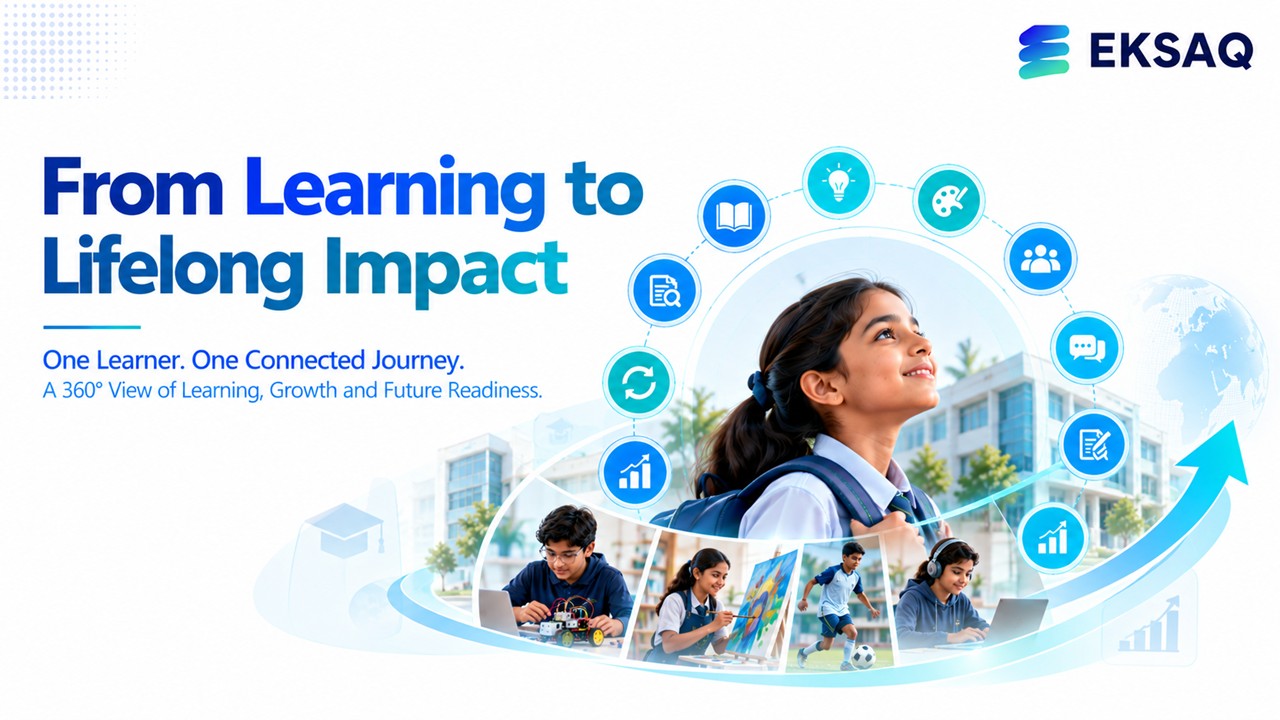
Conclusion: From Learning to Lifelong Impact
The future of education cannot be adequately represented by marks and grades alone. Learners need opportunities to know, understand, apply, create, collaborate, communicate, reflect, adapt and grow. Schools also need a practical way to make these dimensions visible without creating disconnected parallel processes.
Learning Journey provides a framework for moving from fragmented activities to one holistic learning journey. By connecting curriculum, competencies, learning experiences, assessments, evidence, feedback, interventions, reflection, portfolios, analytics and reporting, schools can develop a more complete and actionable understanding of every learner.
One Learner. One Connected Journey. A 360-degree View of Learning, Growth and Future Readiness.
Executive Deck: From Fragmented Activities to One Holistic Learning Journey
About This Video Briefing
This executive briefing explores the critical role of Foundational Literacy and Numeracy (FLN) in shaping student trajectories, school effectiveness, and national progress under NEP 2020 and NIPUN Bharat.